

Projects
Content Strategy: Information Architecture
Information Architecture
Information architecture is the organizing and reorganizing of pages, documents, or text. This new structure make it easier for users to find, store, and browse types of documents. These types of documents are often websites, documents, and applications.
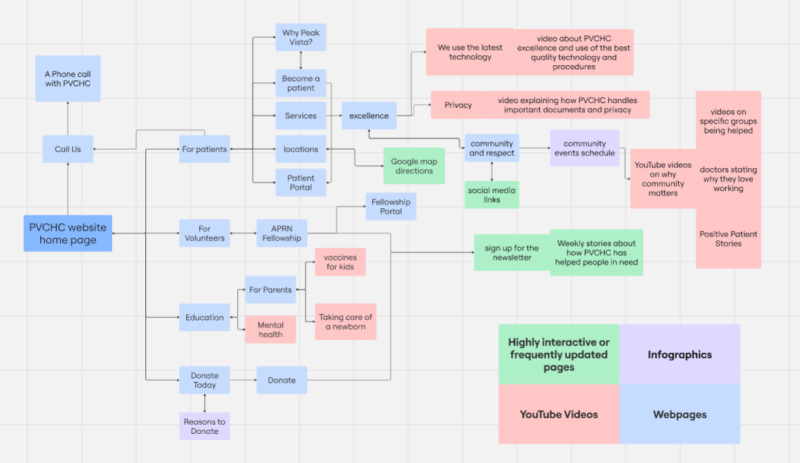
This project was to help a non-profit, Peak Vista Community Health Centers, optimize their website. I created this diagram to help redesign their website layout. This project taught me about the importance of putting the user's interests first. For example, the original website was one of several websites for the same non-profit. My design helped people find and connect with the non-profit through social media. I also constructed the whole site with each different user group in mind. For example, it was originally difficult to find information about volunteering, donating, and education, because that information was scattered at the end of YouTube videos and Facebook posts. Most of the information on their actual website was for patients. Making these changes made using the website easier and less time-consuming.
How To Play A Song On A Native American Style Flute
Instructional Guidance and Safety Writing
Instructional guidance and safety writing informs users on how to properly handle the product. It includes writing steps to ensure users can use the product appropriately. It also provides components names and their functions. The desired result is that users understand maintenance protocols and safety concerns.
This project was completed for the introductory class in the Technical Communication and Information Design Major at UCCS. The objective was to create a user-ready instruction manual for one beginner level task. The target audience was middle schoolers who just got the instrument for the first time and wanted to learn the basics fast. The task was to play a song with legato, staccato, and high notes, with five different fingerings for users to learn. This assignment focused on three elements: safety, clear procedural writing, and illustration.
Brainstorming for PPORA: Analogous Inspiration
Pikes Peak Outdoor Recreation Alliance: Geographic Information System Data Hub Redesign
Analogous Inspiration
Analogous inspiration is a form of brainstorming that involves finding an unrelated task that can provide insight that will help solve the problem at hand.
Part 1: Sketching & Brainstorming
This part of the project was all about creating ideas for a redesign of the PPORA website. I was inspired by The Weather Channel and equalizers for music production and streaming. The audience for this idea would be conservationists, people wanting to develop new building projects, and people who need to decide where to put trails and when to do maintenance.
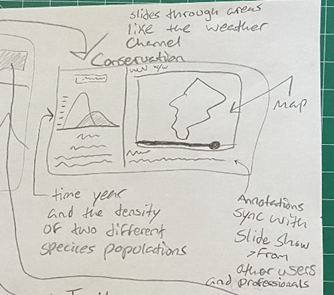
The sketch to the left was part of my original brainstorming. Similar to a weather station, the idea was to flip through the different counties. This demonstrated a completely different user experience. I felt that the user would not want to wait for the county to appear.
The original idea was to create a graph with information about conservation efforts. This can show the time of year, the density of two different population of species, and how they overlap throughout the year in a particular county. This is similar to an equalizer in music production software like GarageBand. I realized that even though this was a possible option, it would have been too complex to have added, given the time allowed for the project.
Part 2: The High-Fidelity Prototype
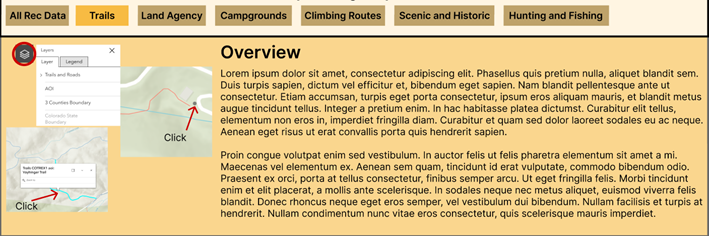
I ended up only using one aspect of the weather map idea. That idea can be seen in the image to the right. The idea morphed into a tutorial where users could scroll through different tabs about how to use the map in the website. This shows that even though analogous inspiration may not initially seem useful, it still leads to interesting ideas for usability.